


Case History – TDE prognose Deployment #1 (December 2025)
Real-time hydraulics + torque-and-drag analytics delivering measurable drilling time savings
TIME SAVINGS (WELL 3 VS WELL 2)
OMV Petrom, the largest integrated energy producer in Southeastern Europe, is constantly seeking to sharpen drilling performance and reduce invisible inefficiencies that accumulate across a well—connection-to-connection, trip-to-trip, and section-to-section. The challenge wasn’t a lack of data; it was turning that data into continuous, actionable engineering insight—fast enough to influence decisions while operations were still in motion.
To address this, OMV Petrom deployed TDE prognose, a standalone real-time engineering system for hydraulics and torque-and-drag analysis. Designed for flexible adoption, TDE prognose can run independently within the TDE platform ecosystem (TDE trace) or be fully embe
dded within SiteCom for integrated operations—supporting different operational setups without compromising the engineering depth required on the rig.
The Solution: Continuous evaluation—offline test and real-time drilling analysis
TDE prognose brings two complementary capabilities together in one workflow:
- Static (offline) planning simulations, enabling teams to test scenarios and align on operational plans before execution.
- Real-time (transient) drilling analysis, enabling real‑time performance monitoring across all operational phases, allowing the team to adjust workflows based on actual wellbore behavior rather than predetermined planning assumptions
A key differentiator is machine-learning calibration: TDE prognosis models continuously recalibrate their predictions by ingesting relevant offset‑well data, enhancing the reliability of drilling parameter recommendations and ensuring that operational guidance remains tightly aligned with actual downhole performance trends as the campaign advances.
Deployment Journey: from pilot to operations (May-November 2025)
For a period of 7 months in year 2025, TDE prognose started a pilot in two phases with the operator:
- Trial system on Well 2, validating performance and fit-for-purpose workflows in operational conditions.
- Full deployment on Well 3, extending TDE prognose operation in real time throughout two key hole sections.
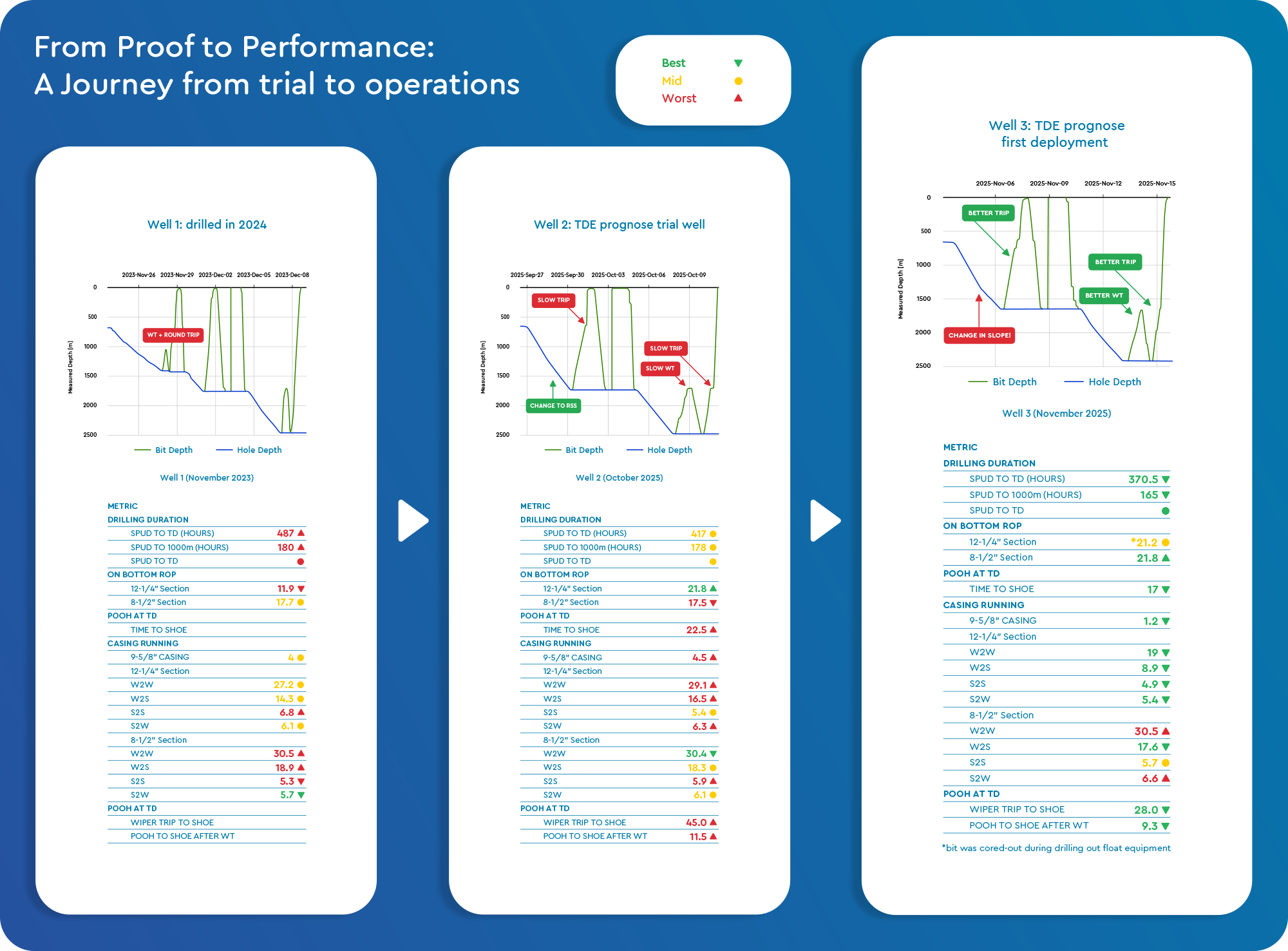
To quantify the impact and identify additional optimization opportunities, Well 3 performance was benchmarked against two recent offsets: Well 2 and Well 1. This comparison approach allowed the operator to assess improvements not as isolated “good days,” but as measurable gains relative to recent comparable performance.
Results: 43,7 hours of total well 3 operational time savings vs Well 2
The full deployment on Well 3 delivered 43,7 hours of total operational time savings relative to Well 2—with improvements visible across both key hole sections.
12-1/4” section: 17.5 hours reduction in normalized drilling time
In the 12-1/4” section, Well 3 achieved a 17,5-hour reduction in normalized drilling time. The gains were driven by operational improvements that compound quickly in day-to-day execution:
- Smoother connections
- Faster trip-out operations
- More efficient casing running
Crucially, these improvements were enabled by TDE prognose derived recommendations on flow rate, demonstrating how real-time engineering guidance can influence the small operational choices that ultimately determine section performance.
8-1/2” section: 26.2 hours improvement with standout drilling efficiency
In the 8-1/2” section, Well 3 recorded the fastest drilling time, the highest on-bottom ROP, and more efficient tripping among all wells—resulting in 26.2 hours of improvement. This section performance reinforced the value of continuous real-time evaluation: the system wasn’t just tracking outcomes; it supported the conditions for faster drilling and smoother operational transitions.
Operational Impact: Driving more consistent execution, improved hole quality, a
nd more robust optimization of drilling parameters
Across both hole sections, the outcome was clear: TDE prognose enhanced drilling execution, hole cleaning, and parameter optimization. The improvements were not limited to one isolated KPI; they appeared in the practical building blocks of performance—drilling efficiency, tripping efficiency, and section-level time reductions that matter directly to well delivery.
Taken together, these results support a compelling next step: further deployment of TDE prognose across the operator’s rig fleet to improve performance consistency and operational efficiency. With proven time savings in full deployment mode, the case demonstrates
how real-time engineering systems can move beyond monitoring and become a driver of repeatable performance improvement.
Key Takeaways
Two-phase adoption (trial → full deployment) enabled validation before scaling.
- Real-time operation across key hole sections delivered measurable section-level and well- level gains.
- 43.7 hours well 3 total time savings vs Well 2, driven by improvements in normalized drilling time, tripping efficiency, and on-bottom ROP.
- Flow-rate recommendations contributed directly to execution improvements in the 12- 1/4” section.
Results justify fleet-wide rollout to raise consistency and efficiency.